🪐 Solar System Quiz
Our solar system is a vast and fascinating place — eight planets, dozens of moons, countless asteroids, and a star at the center of it all. This solar system quiz tests your knowledge of planets, their characteristics, the Sun, and the key objects that orbit it. From the smallest planet to the largest moon, see how well you know our cosmic neighborhood.
Answers Explained
Q: Why is Venus hotter than Mercury despite being farther from the Sun?
A: Venus has a dense atmosphere of carbon dioxide that traps heat through the greenhouse effect.
Mercury has virtually no atmosphere, so heat escapes into space. Venus's thick CO₂ atmosphere acts like a blanket, raising surface temperatures to around 465°C — hot enough to melt lead.
Q: Why was Pluto reclassified as a dwarf planet?
A: Pluto has not cleared the neighborhood around its orbit, one of the three criteria for full planet status.
In 2006, the International Astronomical Union (IAU) defined a planet as a celestial body that orbits the Sun, has sufficient mass for gravity to make it roughly spherical, and has cleared its orbital neighborhood. Pluto fails the third criterion because it shares its orbit with other Kuiper Belt Objects.
Q: What makes Saturn's rings so distinctive?
A: Saturn's rings are wide, bright, and made primarily of water ice — up to 99% ice in some regions.
Saturn's main rings span about 280,000 km but are surprisingly thin — often less than 100 meters thick. The Cassini mission (2004–2017) revealed the rings are relatively young, possibly 10–100 million years old, formed from a destroyed moon or captured comet.
Frequently Asked Questions
How many planets are in our solar system?
There are 8 planets in our solar system: Mercury, Venus, Earth, Mars, Jupiter, Saturn, Uranus, and Neptune. Pluto was reclassified as a dwarf planet in 2006.
What is the largest planet in the solar system?
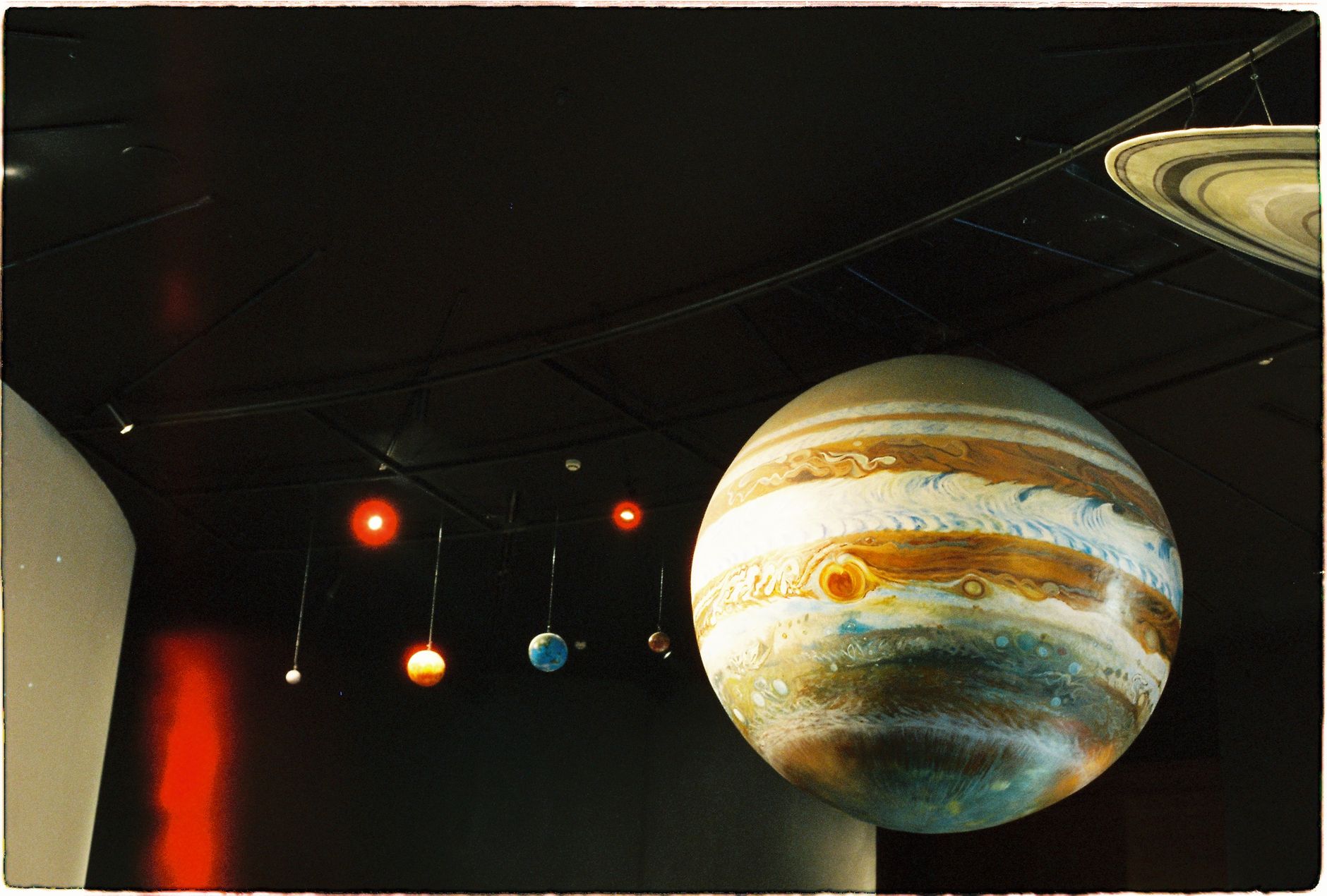
Jupiter is the largest planet in our solar system. It is so large that all other planets could fit inside it with room to spare.
How far is the Sun from Earth?
The Sun is approximately 150 million kilometers (93 million miles) from Earth. This distance is called 1 Astronomical Unit (AU).
What is the hottest planet in the solar system?
Venus is the hottest planet with average surface temperatures around 465°C (869°F), even hotter than Mercury despite being farther from the Sun, due to its thick greenhouse atmosphere.
How long does it take light from the Sun to reach Earth?
Light from the Sun takes approximately 8 minutes and 20 seconds to reach Earth, traveling at 299,792 km/s.