Space Exploration Quiz
From Yuri Gagarin's historic orbit to the Perseverance rover exploring Mars, humanity's journey into space is filled with astonishing achievements, breathtaking discoveries, and moments of heartbreak. This Space Exploration Quiz challenges you with 12 questions covering NASA missions, Soviet space milestones, rocket science, planets, telescopes, and the future of space travel. Whether you're a casual stargazer or a dedicated space enthusiast, this is your chance to find out how much you really know about the final frontier.

Space exploration has transformed our understanding of the universe. In 1957, the Soviet Sputnik became the first object to orbit Earth, launching the Space Race. Just twelve years later, Neil Armstrong stepped onto the Moon — an achievement watched by 600 million people worldwide. Today, private companies like SpaceX are revolutionising access to orbit, while NASA's Artemis programme aims to return humans to the Moon and eventually send the first crewed mission to Mars. Behind every mission are thousands of engineers, scientists, and astronauts who pushed the boundaries of what was thought possible. Test how much of this remarkable history you know!
Answers Explained
Q: Why does Mars appear red?
A: Because its surface is rich in iron oxide (rust).
Mars gets its distinctive reddish-orange colour from iron oxide — commonly known as rust — that coats its rocky surface and dust. When fine Martian dust is kicked into the atmosphere by dust storms (which can envelop the entire planet), it turns the sky a butterscotch-pink colour. The iron oxide formed billions of years ago when the planet had liquid water and a thicker atmosphere.
Q: How long does it take to travel from Earth to Mars?
A: Approximately 7 to 9 months depending on orbital alignment.
The time needed to travel to Mars depends on the positions of both planets in their orbits. Using current chemical rocket technology and a Hohmann transfer orbit, a trip takes between 7 and 9 months. Mars and Earth align favourably for launch roughly every 26 months, which is why most missions are planned around these launch windows.
Q: What was the Space Shuttle programme?
A: NASA's reusable spacecraft programme that operated from 1981 to 2011.
The Space Shuttle was NASA's reusable crewed spacecraft that flew 135 missions over 30 years. Five orbiters flew: Columbia, Challenger, Discovery, Atlantis, and Endeavour. Tragically, Challenger was lost in 1986 and Columbia in 2003, killing seven crew members each time. The programme was retired in 2011 and replaced by commercial crew vehicles like SpaceX's Crew Dragon.

Frequently Asked Questions
Who was the first human to walk on the Moon?
Neil Armstrong became the first human to walk on the Moon on July 20, 1969, during NASA's Apollo 11 mission.
How many moons does Saturn have?
Saturn has 146 confirmed moons as of 2023, making it the planet with the most moons in our solar system. Its largest moon, Titan, has a thick atmosphere and liquid methane lakes.
When was the International Space Station launched?
The first module of the ISS, the Russian Zarya module, was launched on November 20, 1998. Continuous human habitation began in November 2000, and the station has been occupied ever since.
What is the nearest star to Earth besides the Sun?
Proxima Centauri, part of the Alpha Centauri star system, is the nearest star to Earth at approximately 4.24 light-years away. It is a small red dwarf star located in the constellation Centaurus.
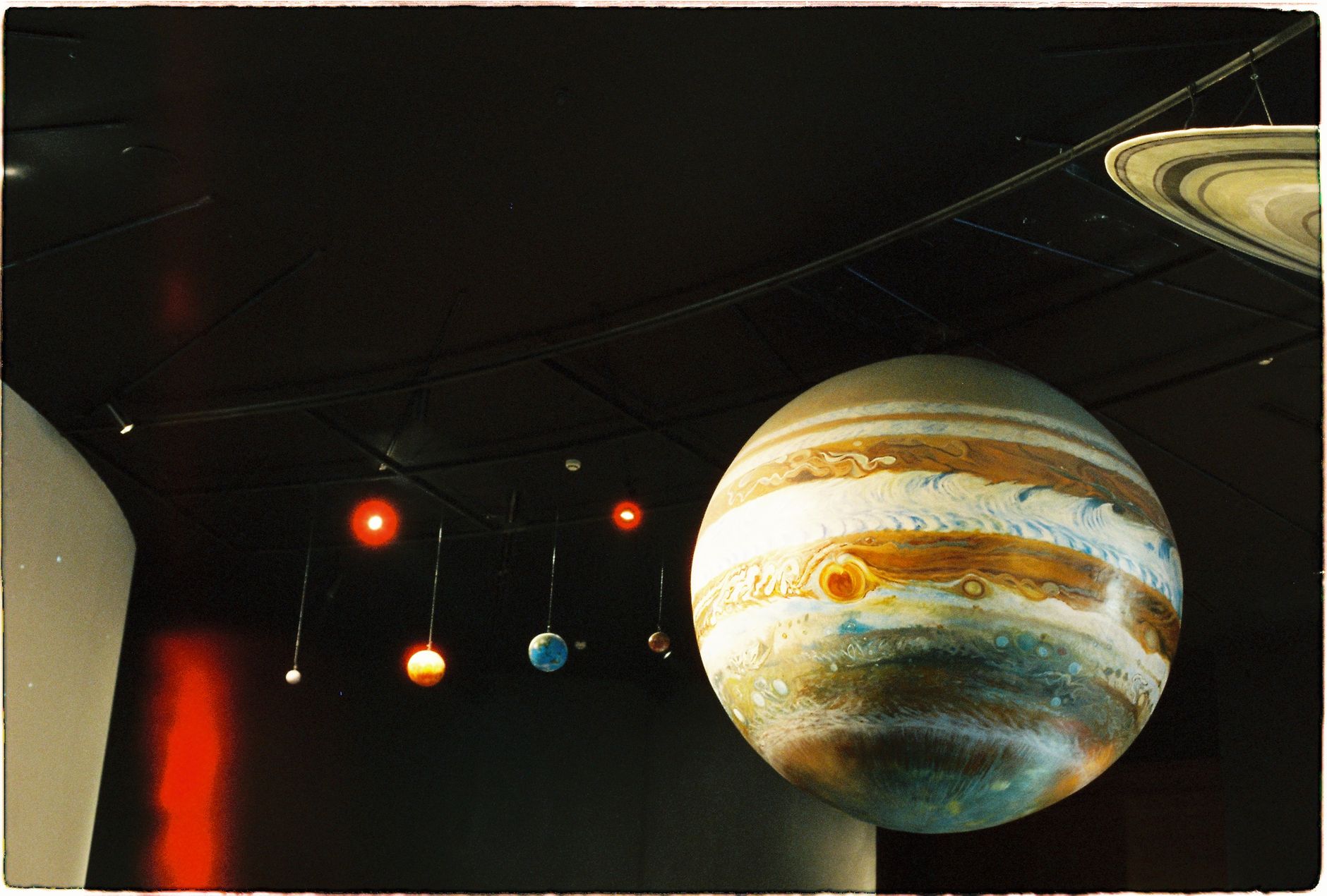
What is the largest planet in our solar system?
Jupiter is the largest planet in our solar system, with a diameter of about 139,820 km — more than 11 times that of Earth. Its iconic Great Red Spot is a storm that has been ongoing for at least 350 years.